Jesus
and the Law
The function of the law
Christ fulfills the law (Matt
Ray Comfort elaborates upon this idea (especially as it is related to evangelism) at:
http://www.raycomfort.com/listenwatch/
1 Tim 1:8‑11
8 We know that
the law is good if one uses it properly.
The law defines sin
1 John 3
4 Whosoever committeth sin transgresseth also the
law: for sin is the transgression
of the law.
Rom
3:19-31
19 Now we know that whatever the law says,
it says to those who are under the law, so that every mouth may be silenced and
the whole world held accountable to God.
20 Therefore no one will be declared
righteous in his sight by observing the law; rather, through the law we
become conscious of sin.
21 But now a righteousness from God, apart
from law, has been made known, to which the Law and the Prophets testify.
22 This righteousness from God comes
through faith in Jesus Christ to all who believe. There is no difference,
23 for
all have sinned and fall short of the glory of God,
24 and are justified freely by his grace
through the redemption that came by Christ Jesus.
25 God presented him as a sacrifice of
atonement, through faith in his blood. He did this to demonstrate his justice,
because in his forbearance he had left the sins committed beforehand
unpunished--
26 he did it to demonstrate his justice at
the present time, so as to be just and the one who justifies those who have
faith in Jesus.
27 Where, then, is boasting? It is
excluded. On what principle? On that of observing the law? No, but on that of
faith.
28 For we maintain that a man is justified
by faith apart from observing the law.
29 Is God the God of Jews only? Is he not
the God of Gentiles too? Yes, of Gentiles too,
30 since there is only one God, who will
justify the circumcised by faith and the uncircumcised through that same faith.
31 Do we, then, nullify the law by this
faith? Not at all! Rather, we uphold the law. (NIV)
Rom 7:7
7 What shall
we say, then? Is the law sin? Certainly not! Indeed I would not have
known what sin was except through the law. For I would not have known what
coveting really was if the law had not said, "Do not covet." (NIV)
Gal 3:21-24
21 Is the law,
therefore, opposed to the promises of God? Absolutely not! For if a law had
been given that could impart life, then righteousness would certainly have come
by the law.
22 But the
Scripture declares that the whole world is a prisoner of sin, so that
what was promised, being given through faith in Jesus Christ, might be given to
those who believe.
23 Before this
faith came, we were held prisoners by the law, locked up until faith should be
revealed.
24 So the law was put in charge to lead us to Christ that we might be justified by faith. (NIV)
Why did Jesus die?
He died to
fulfill all 3 main aspect of His law:
1.
Ceremonial - Heb 9:22-28 and Col 2:16‑17 are
explained below.
2.
Political – by establishing His Kingdom in individual
hearts (spiritual
Rom
No, a man is a Jew if he is one inwardly; and circumcision
is circumcision of the heart, by the Spirit, not by the written code. Such a
man's praise is not from men, but from God. (NIV)
3.
Moral -
Hebrews 9
15For this reason Christ is the
mediator of a new covenant, that those who are
called may receive the promised eternal inheritance--now that he has
died as a ransom to set them free from the sins committed under the first covenant.
So the new
covenant defines sin the same way as the old covenant: by the law.
Who is the “them” referred to
above? The writer of Hebrews identifies
them as those who are called. Are you called? Then your sins are also judged by the
standard of God’s moral law.
To lead us to Christ
Therefore,
you should:
1.
read God’s moral law in the Old and New Testament
1.
repent of your
transgressions of it
2.
obey its commands until death
If you do
not do this, it shows that you do not care about not sinning against God. An obedient believer would never have this attitude.
Psalm
119:11
I have hidden your word in my heart that I might not sin against you.
(Whole Chapter: Psalm
119 In context: Psalm
119:10-12)
1 John 3
4 Everyone who practices sin also practices lawlessness; and (1)
sin is lawlessness.
Anyone who
truly believes that Jesus died for their sins
will avoid sin at all cost.
Matt
5:27-30
27 "You have heard that it was said,
'Do not commit adultery.'
28 But I tell you that anyone who looks at
a woman lustfully has already committed
adultery with her in his heart.
29 If your right eye causes you to sin,
gouge it out and throw it away. It is better for you to lose one part of your
body than for your whole body to be thrown into hell.
30 And if your right hand causes you to
sin, cut it off and throw it away. It is better for you to lose one part of
your body than for your whole body to go into hell. (NIV)
Mark
16:16
Whoever believes and is baptized will be
saved, but whoever does not believe will be condemned.
(Whole Chapter: Mark
16 In context: Mark
16:15-17)
To kill us
Romans
7:4
So, my brothers, you also died to the law through the body of
Christ, that you might belong to another, to him who was raised from the dead,
in order that we might bear fruit to God.
(Whole Chapter: Romans
7 In context: Romans
7:3-5)
In order
to be truly born again, we must first
die. The law confronts us with our own
wicked behavior and tendencies: our own deadness.
Romans
6:16
Don't you know that when you offer yourselves to someone to obey him as slaves,
you are slaves to the one whom you obey–whether you are slaves to sin, which
leads to death, or to obedience, which leads to
righteousness?
(Whole Chapter: Romans
6 In context: Romans
6:15-17)
By
becoming a slave to obedience, instead of sin, we die to sins.
1
Peter 2:24
He himself bore our sins in his
body on the tree, so that we might die to sins and live for
righteousness; by his wounds you have been healed.
(Whole Chapter: 1
Peter 2 In context: 1
Peter 2:23-25)
NOT to abolish, but to fulfill the Law. (Matt 5:17‑19)
Rom 10:4
4 Christ is
the end [goal] of the law so that there may be righteousness for everyone who
believes. (NIV)
|
Christ fulfills the law (Matt 5:17),
|
Matthew
Henry explains this passage--
Romans 10:1‑11
PP14
(1.) Christ
is the end of the ceremonial law; he is the period of it, because he is
the perfection of it. When the substance comes, the shadow is gone. The sacrifices, and offerings, and
purifications appointed under the Old Testament, prefigured Christ, and pointed
at him; and their inability to take away sin discovered the necessity of a sacrifice that should, by being once
offered, take away sin.
(from Matthew Henry's Commentary)
Bracketed text above is
mine. I inserted the word “goal’ because
the Greek word “teleo” can be translated as “goal” or “end”.
Good bye to Ceremonial Law:
Ceremonial
Law is now unnecessary, since the perfect picture/image of it is Christ.
Heb 9:22-28
22 In fact, the law requires that nearly everything be cleansed with blood, and without the shedding of blood there is no forgiveness.
23 It was
necessary, then, for the copies of the heavenly things to be purified with
these sacrifices, but the heavenly things themselves with better sacrifices
than these.
24 For Christ
did not enter a man-made sanctuary that was only a copy of the true one; he
entered heaven itself, now to appear for us in God's presence.
25 Nor did he
enter heaven to offer himself again and again, the way the high priest enters
the Most Holy Place every year with
blood that is not his own.
26 Then Christ
would have had to suffer many times since the creation of the world. But now he
has appeared once for all at the end of the ages to do away with sin by the
sacrifice of himself.
27 Just as man
is destined to die once, and after that to face judgment,
28 so Christ
was sacrificed once to take away the sins of many people; and he will appear a
second time, not to bear sin, but to bring salvation to those who are waiting
for him. (NIV)
Col 2:16‑17
16 Therefore do
not let anyone judge you by what you eat or drink, or with regard to a
religious festival, a New Moon celebration or a Sabbath day.
17 These are a shadow of the things that were
to come; the reality, however, is found in Christ. (NIV)
So much for the Political Law:
R. A.
Torrey’s Topical Textbook refers to this type of God’s laws as the “Civil laws”. These laws are based in God’s mode of
expressing himself culturally via a theocracy.
Deuteronomy 17
9 Go to the priests, who are Levites, and to the judge who is in office at that time. Inquire
of them and they will give you the verdict.
Well, who’s
in office today? This “civil” portion of
the law had a clear beginning via Moses, and a not-so-clear end in the
destruction of the Jerusalem city/state shortly after the death of Jesus. Much
like the destruction of the temple during this same siege made obedience to the
ceremonial law impossible, the judges of the Israeli city/state no longer had
civil authority to obey these types of commands.
This did
not surprise God or his prophets. Most
Rabbis expected Messiah to “magnify” the law:
To bring new light on it, or to make it bigger:
Isaiah 42
21 It pleased the LORD
for the sake of his righteousness
to make his law great and glorious.
This is
what Jesus did. He took the law that He
had given one culture, and applied the moral law to all cultures. He even prophesied this historical event in
the “Old” Testament.
Jeremiah
31:32
29 "In those days people will
no longer say,
'The fathers have eaten sour grapes,
and the children's teeth are set on edge.'
30 Instead, everyone will die for his own sin; whoever eats sour
grapes-his own teeth will be set on edge.
31 "The time is coming," declares the LORD ,
"when I will make a new covenant
with the house of Israel
and with the house of Judah.
32 It will not be like the covenant
I made with their forefathers
when I took them by the hand
to lead them out of Egypt,
because they broke my covenant,
though I was a husband to [4]
them, [5]
"
declares the LORD .
33 "This is the covenant I will make with the house of Israel
after that time," declares the LORD .
"I will put my law in their minds
and write it on their hearts.
I will be their God,
and they will be my people.
34 No longer will a man teach his neighbor,
or a man his brother, saying, 'Know the LORD ,'
because they will all know me,
from the least of them to the greatest,"
declares the LORD .
"For I will forgive their wickedness
and will remember their sins no more."
In this
passage, do you notice the shift in emphasis from the National to the personal
relationship with God?
Culture and Morality
Morality
is an aspect of humanity, not of only one particular culture. God redeemed a culture or a nation: Israel.
He revealed himself culturally and politically. He incarnated within that culture at a time
of great religious revival. He was
understood and received by a few who were expecting Him and could see his fulfillment
of scripture. He was surprisingly uninvolved with politics. He did not set up an earthly kingdom for
himself. He did not even open a
church. The Father sent the Holy Spirit
to do that on the day of Pentecost.
Israel is located at the crossroads of 3 continents. From there His followers obeyed his command:
Matthew 28
18Then Jesus came to them and said, "All authority in heaven
and on earth has been given to me. 19Therefore go and make disciples of all nations, baptizing them in[1]
the name of the Father and of the Son and of the Holy Spirit, 20and teaching them to obey everything I have
commanded you. And surely I am with you always, to the very end of the
age."
It makes
sense. Think of this scenario: What if the Father incarnated on a remote
island among a tribe with no concept of God being one, of morality being
absolute, of humans breeching God’s absolute standard of morality as something
that hurts Him and them, even to the point of death for both?
I met a
missionary to Papua New Guniea, who worked a few tribes over from the tribe
featured in the “Et Tau” video,
described their method of evangelizing a new tribe. They spend weeks or months teaching stories
from the Old Testament exclusively, before they even mention Jesus or the
Gospel. Why? I don’t know, maybe they learned the hard way
about cultural revelation of truth. Most
people believe what their culture or subculture believes. This is especially true for new tribes who
make a collective decision on whether to follow Christ or not. I have noticed that it is true also for even
the most “independent” Americans too.
They tend to believe the same as whoever they are hanging around with.
So, as
Paul says, we who are gentiles have become part of Israel through faith in
Jesus. We were not born again into a new
government (or nation), or an earthly priesthood, but we do have a different culture—and
it is based in Old Testament Judaism.
This is because it is very difficult to completely separate culture from
morality.
Culture is
an elusive term, and I’m sorry if I am confusing the issue. I’m not writing about “Christian
Culture”. It is obviously not very
Jewish or Old or New Testament. The New
Testament was written by practicing Jews—and often addressed to Gentiles.
Colossians 2
16Therefore do not let anyone judge
you by what you eat or drink, or with regard to a religious festival, a New Moon celebration or a Sabbath day. 17These are a
shadow of the things that were to come; the reality, however, is found in
Christ.
We can
classify the religious festivals as both ceremonial and civil, perhaps, since
the government has to be involved with holidays of that magnitude to some
degree. The Sabbath day seems to be
included in this list of laws that are not binding on Gentiles. That is confusing to many because it appears
as one of the Ten Commandments, which are typically considered to be the summed
essence of God’s morality.
This leads
us to Torrey’s third classification of Old Testament laws. How do we classify biblical laws which are
neither ceremonial nor civil? What we
are left with Torrey refers to as the “Moral Law”.
Did God’s morality change?
God’s morality, his moral law, has not
changed. While the ceremonial and civil
law can not be followed, God’s moral law is still right. God’s morality, or standards of what is right
and wrong, has not changed. I do not understand how
God's morality could change. Is His
index of what is right and wrong different now?
James 1:17
17
Every good and perfect gift is from above, coming
down from the Father of the heavenly lights, who does not change like
shifting shadows.
Heb
13:7-8
7 Remember your leaders, who spoke the
word of God to you. Consider the outcome of their way of life and imitate their
faith.
8 Jesus Christ is the same yesterday
and today and forever. (NIV)
Should you not make restitution to those from whom you have stolen, since you are free from the law? What is right (as spelled out by the moral law) is still right. Jesus is the end of the moral law in that He has paid the price for the believer’s transgressions of it. That does not mean that we should ignore or cast away God’s moral law?
Paul "upholds" the law.
Rom 3:31
31 Do we, then, nullify the law by this faith? Not at all! Rather, we uphold the law. (NIV)
We
uphold the law as right, asking forgiveness of our transgressions of it. We respect
the price he payed, and pays for each of our transgressions. Thus, we wish to
uphold the moral law, now written on our hearts, to avoid hurting our God and
Savior. The admission that God’s morals (moral law) are right, and our behavior
is wrong is essential to understanding and receiving salvation through our
Messiah.
Christ’s example
Jesus
upheld the law, and we are to "Walk as Jesus did".
I Jn 2:1-7
1 My dear children, I write this to you so that you will not sin. But if
anybody does sin, we have one who speaks to the Father in our defense-- Jesus
Christ, the Righteous One.
2 He is the atoning sacrifice for our sins, and not only for ours but also
for the sins of the whole world.
3 We know that we have come to know
him if we obey his commands.
4 The man who says, "I know him," but does not do what he
commands is a liar, and the truth is not in him.
5 But if anyone obeys his word,
God's love is truly made complete in him. This is how we know we are in him:
6 Whoever claims to live in him must
walk as Jesus did.
7 Dear friends, I am not writing you a new command but an old one,
which you have had since the beginning. This old command is the message you
have heard. (NIV)
The moral law remains
God’s standard of perfection, which Jesus commands us to keep:
Matt
48
Be perfect,
therefore, as your heavenly Father is perfect.
(NIV)
We are
called to perfection, but forgiven of our shortcomings when we agree with
God’s law: That they are shortcomings or sins. 1 John 2
1My dear children, I write this to you so that you will not sin.
But if anybody does sin, we have
one who speaks to the Father in our defense--Jesus Christ, the Righteous
One. 2He is the atoning sacrifice for our sins, and not only for
ours but also for[1]
the sins of the whole world.
Heb
5:7-10
7 During the days of Jesus' life on
earth, he offered up prayers and petitions with loud cries and tears to the one
who could save him from death, and he was heard because of his reverent
submission.
8 Although he was a son, he learned
obedience from what he suffered
9 and, once made perfect, he
became the source of eternal salvation for all who obey him
10 and was designated by God to be high
priest in the order of Melchizedek. (NIV)
Jesus and Stephen the
martyr rebuked the Jewish religious rulers for breaking the moral law:
Matt 15:3‑9
3
Jesus replied, "And why do you break the command of God for the sake of your tradition? (NIV)
Acts 7
52Was there ever a prophet your fathers did not persecute?
They even killed those who predicted the coming of the Righteous One. And now
you have betrayed and murdered him-- 53you who have received the law that was
put into effect through angels but have not obeyed it."
54When they heard this, they were furious and gnashed their
teeth at him.
Acts 7
52Was there ever a prophet your fathers did not persecute? They even
killed those who predicted the coming of the Righteous One. And now you have
betrayed and murdered him-- 53you who have received the law that was put into effect through angels but have not obeyed it."
Paul adds,
Col
1:28-29
28 We proclaim him, admonishing and
teaching everyone with all wisdom, so that we may present everyone perfect
in Christ.
29 To this end I labor, struggling with
all his energy, which so powerfully works in me.
(NIV)
If we were to struggle
with all His energy, to this same end, the His energy (dunamis) would work
powerfully in us today as well.
Heb
13:7-8
7 Remember your leaders, who spoke the
word of God to you. Consider the outcome of their way of life and imitate their
faith.
8 Jesus Christ is the same yesterday
and today and forever. (NIV)
Rom
15:18-20
18 I will not venture to speak of anything
except what Christ has accomplished through me in leading the Gentiles to
obey God by what I have said and done--
19 by the power of signs and miracles,
through the power of the Spirit. So from Jerusalem all the way around to
Illyricum, I have fully proclaimed the gospel of Christ.
20 It has always been my ambition to preach
the gospel where Christ was not known, so that I would not be building on
someone else's foundation. (NIV)
James 1:21-25
21 Therefore, get rid of all moral filth and the evil that is so prevalent and humbly accept the word planted in you, which can save you.
22 Do
not merely listen to the word, and so deceive yourselves. Do what it says.
23 Anyone who listens to the word but does not do what it says is like a man who looks at his face in a mirror
24 and,
after looking at himself, goes away and immediately forgets what he looks like.
25 But
the man who looks intently into the perfect law that gives freedom, and
continues to do this, not forgetting what he has heard, but doing it-- he will
be blessed in what he does. (NIV)
Lawlessness
This next
section debunks myths taught by lawless men who
you need to be on guard against.
2
Peter 3:17
Therefore, dear friends, since you already know this, be on your guard so that
you may not be carried away by the error of lawless men and fall from
your secure position.
(Whole Chapter: 2
Peter 3 In context: 2
Peter 3:16-18)
1 John 3
4 Everyone who practices sin also practices
lawlessness; and (1)
sin is lawlessness.
Old vs. New?
“That’s just the Old Testament, we are in the New
Covenant now…”
1
Cor 10:1-15
1 For I do not want you to be ignorant
of the fact, brothers, that our forefathers were all under the cloud and that
they all passed through the sea.
2 They were all baptized into Moses in
the cloud and in the sea.
3 They all ate the same spiritual food
4 and drank the same spiritual drink;
for they drank from the spiritual rock that accompanied them, and that rock was
Christ.
5 Nevertheless, God was not pleased with most of them; their bodies were scattered over the desert.
6 Now these things occurred as
examples to keep us from setting our hearts on evil things as they did.
7 Do not be idolaters, as some of them
were; as it is written: "The people sat down to eat and drink and got up
to indulge in pagan revelry."
8 We should not commit sexual
immorality, as some of them did-- and in one day twenty-three thousand of them
died.
9 We should not test the Lord, as some
of them did-- and were killed by snakes.
10 And do not grumble, as some of them
did-- and were killed by the destroying angel.
11 These things happened to them as examples and were written down as warnings for us, on whom the fulfillment of the ages has come.
12 So, if you think you are standing firm, be careful that you don't fall!
13 No temptation has seized you except
what is common to man. And God is faithful; he will not let you be tempted
beyond what you can bear. But when you are tempted, he will also provide a way
out so that you can stand up under it.
14 Therefore, my dear friends, flee from
idolatry.
15 I speak to sensible people; judge for
yourselves what I say.
(NIV)
1 Cor
Now all these things happened
to them as examples, and they were written for
our admonition, upon whom
the ends of the ages have come. (NKJV)
Now these things happened to
them as an <*1> example, and <*2> they were
written for our instruction,
upon whom <*3> the ends of the ages have come.
(NASB)
Paul specifically warns those who
discredit the Tanuch, or “Old Testament”, to “be careful that you don't
fall!” He validates the warnings in the
Tanuch as applicable to the “New Covenant” believer. For, they were “written
down as warnings for us”.
Also, keep in mind that Jesus and the Apostles only preached from the
Old Testament. From it, they clarified
the Father’s message in Christ.
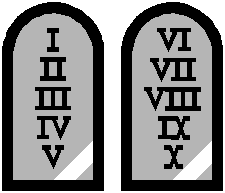
Matt 5:17‑19
17 "Do not think that I have come
to abolish the Law or the Prophets; I have not come to abolish them but to
fulfill them.
18 I tell you the truth, until heaven and
earth disappear, not the smallest letter, not the least stroke of a pen, will
by any means disappear from the Law until everything is accomplished.
19 Anyone who breaks one of the least of these commandments and teaches others
to do the same will be called least in the kingdom of heaven, but whoever
practices and teaches these commands will be called great in the kingdom of
heaven. (NIV)
John 17:17
17Sanctify
them by the truth; your word is truth.
When Jesus was referring to God’s word, he could have only been referencing the Old Testament. Since the new was not yet written.
Jesus vs. the Law?
Her’es a
dumb idea that is not in the Bible:
“There is a mean God with a long list of laws, but there is a nice younger Jesus who takes all that away, so we do not have to worry about it since 30 AD.”
Jesus did
not defeat the Law, like Godzilla vs. Megalon.
That would be disrespecting Himself--God. He considered Himself one with the Father,
and the Words of Moses, the Law.
John 5:46‑47
46 If you
believed Moses, you would believe me, for he wrote about me.
47 But since
you do not believe what he wrote, how are you going to believe what I
say?"
(NIV)
In verse
46 above, Jesus makes clear that a true believer in the Law of Moses would
believe in Him, since Moses was writing about Him. Moses did not write
inaccurately, and He has not changed.
John 1:1-5 GNB
(1) In the
beginning the Word already existed; the Word was with God, and the Word was
God.
(2) From the
very beginning the Word was with God.
(3) Through
him God made all things; not one thing in all creation was made without him.
(4) The Word
was the source of life, and this life brought light to people.
(5) The light
shines in the darkness, and the darkness has never put it out.
Jesus said in John 8:56-58 (GNB)
(56) Your
father Abraham rejoiced that he was to see the time of my coming; he saw it and
was glad."
(57) They said
to him, "You are not even fifty years old---and you have seen
Abraham?"
(58) "I
am telling you the truth," Jesus replied. "Before Abraham was born,
'I Am'."

If the law teaches us anything, it is that we are sinners, in need of an atoning blood sacrifice. Even Noah and Abraham knew that, before the law was given.
Gen
He even knew the difference between clean and unclean animals. I don’t know how he knew that. The bible does not explain these differences until Moses writes of them in his law.
Abraham proved that he was willing to give his life, even his son to God, God gave Abraham a ram to sacrifice, in place of his firstborn. In the same way today, when we give our life to Father, his son’s blood covers our sin, so that we can know Him.
Genesis
22:1-14 GNB
(1)
Some time later God tested Abraham; he called to him,
"Abraham!" And Abraham answered, "Yes, here I am!"
(2)
"Take your son," God said, "your only son, Isaac, whom
you love so much, and go to the
(3)
Early the next morning Abraham cut some wood for the sacrifice, loaded
his donkey, and took Isaac and two servants with him. They started out for the
place that God had told him about.
(4)
On the third day Abraham saw the place in the distance.
(5)
Then he said to the servants, "Stay here with the donkey. The boy
and I will go over there and worship, and then we will come back to you."
(6)
Abraham made Isaac carry the wood
for the sacrifice, and he himself carried a knife and live coals for
starting the fire. As they walked along together,
(7)
Isaac spoke up, "Father!" He answered, "Yes, my
son?" Isaac asked, "I see that you have the coals and the wood, but
where is the lamb for the sacrifice?"
(8)
Abraham answered, "God himself will provide one." And the two
of them walked on together.
(9)
When they came to the place which God had told him about, Abraham built
an altar and arranged the wood on it. He tied up his son and placed him on the
altar, on top of the wood.
(10)
Then he picked up the knife to kill him.
(11)
But the angel of the LORD called to him from heaven, "Abraham,
Abraham!" He answered, "Yes, here I am."
(12)
"Don't hurt the boy or do anything to him," he said. "Now
I know that you honor and obey God, because you have not kept back your only
son from him."
(13)
Abraham looked around and saw a ram caught in a bush by its horns. He
went and got it and offered it as a burnt offering instead of his son.
(14)
Abraham named that place "The LORD Provides." And even today
people say, "On the LORD's mountain he provides."
As an interesting side note, Jesus also carried the wood (verse 6) upon which he was sacrificed, according to His Father’s will.
Jesus vs. the Pharisees, not Jesus vs. the Law!
Jesus did not rebuke the Pharisees for “trying so hard to obey the law”. He would have had to rebuke Himself if that were the case, since He was a sinless and perfect Israelite himself. He chastised them for adding to it, and making up their own law, apart from God’s. In doing this they were neglecting the actual written Word of God. This is what legalism, or “rules taught by men” really is. This is still forbidden today, as He points out again below in Rev 22:18‑19.
Matt 15:3‑9
3 Jesus
replied, "And why do you break the command of God for the sake of your
tradition?
4 For God
said, 'Honor your father and mother' and 'Anyone who curses his father or
mother must be put to death.'
5 But you say
that if a man says to his father or mother, 'Whatever help you might otherwise
have received from me is a gift devoted to God,'
6 he is not to
'honor his father' with it. Thus you nullify the word of God for the sake of
your tradition.
7 You
hypocrites! Isaiah was right when he prophesied about you:
8 "'These
people honor me with their lips, but their hearts are far from me.
9 They worship
me in vain; their teachings are but rules taught by men.'" (NIV)
Matt 23:23-28
23 "Woe to
you, teachers of the law and Pharisees, you hypocrites! You give a tenth of
your spices-- mint, dill and cummin. But you have neglected the more
important matters of the law-- justice, mercy and faithfulness. You should
have practiced the latter, without neglecting the former.
24 You blind
guides! You strain out a gnat but swallow a camel.
25 "Woe to
you, teachers of the law and Pharisees, you hypocrites! You clean the outside
of the cup and dish, but inside they are full of greed and self-indulgence.
26 Blind
Pharisee! First clean the inside of the cup and dish, and then the outside also
will be clean.
27 "Woe to
you, teachers of the law and Pharisees, you hypocrites! You are like
whitewashed tombs, which look beautiful on the outside but on the inside are
full of dead men's bones and everything unclean.
28 In the same
way, on the outside you appear to people as righteous but on the inside you are
full of hypocrisy and wickedness. (NIV)
Rev 22:18‑19
18 I warn
everyone who hears the words of the prophecy of this book: If anyone adds anything
to them, God will add to him the plagues described in this book.
19 And if anyone takes words away from this book of prophecy, God will take away from him his share in the tree of life and in the holy city, which are described in this book. (NIV)
The
Pharisees, Sadducees, and Teachers of the Law in Jesus’ time do not represent
the law of Moses. They had twisted it to
their own destruction (see Jude). They
had added and taken away from it. The
conflict between Christ and these teachers should not be confused as conflict
between Christ and the Law.
 True
believers in the Law are not and have never been self-righteous. Jesus treated
the Pharisees the same way as other “Old Testament” Prophets (like His cousin
John) would treat someone who is self-righteous. Self-Righteous people look to
their own works or “good life” as salvific--and deny that they are sinners in
need of a Savior. They placed their faith in outward observance of the law,
instead of the God of the law. They thought they were justified by their
observance of the rituals, without focusing on the meaning of the rituals.
True
believers in the Law are not and have never been self-righteous. Jesus treated
the Pharisees the same way as other “Old Testament” Prophets (like His cousin
John) would treat someone who is self-righteous. Self-Righteous people look to
their own works or “good life” as salvific--and deny that they are sinners in
need of a Savior. They placed their faith in outward observance of the law,
instead of the God of the law. They thought they were justified by their
observance of the rituals, without focusing on the meaning of the rituals.
For example, some students, when they read out loud for the class, only concentrate on making their reading sound right. When they are done reading, and you ask them about what they just read, they have no idea what the meaning of the passage was. They were not focusing on the meaning. In the same way, the Pharisees focused on “going through the motions” of religious ritual, at the expense of understanding the meaning behind it. Christ is the meaning behind the ritual.
16 Therefore do
not let anyone judge you by what you eat or drink, or with regard to a
religious festival, a New Moon celebration or a Sabbath day.
17 These are a shadow of the things that were
to come; the reality, however, is found in Christ. (NIV)
John 5:46‑47
46 If you
believed Moses, you would believe me, for he wrote about me.
47 But since
you do not believe what he wrote, how are you going to believe what I
say?"
(NIV)
If the Pharisees had understood and believed the meaning of the Law of Moses, they would be trusting in the mercy of God for their salvation from their sin. Thus, they would be prone to accept the incarnate mercy of God in Christ. Since the sacrificial system only postponed God’s judgment of the sins of Israel every year, they would have welcomed an innocent man who, like Isaac, would pay for the sins of the people once and for all time.
John
11:49-53 GNB
(49)
One of them, named Caiaphas, who was High Priest that year, said,
"What fools you are!
(50)
Don't you realize that it is better for you to have one man die for the
people, instead of having the whole nation destroyed?"
(51)
Actually, he did not say this of his own accord; rather, as he was High
Priest that year, he was prophesying that Jesus was going to die for the Jewish
people,
(52)
and not only for them, but also to bring together into one body all the
scattered people of God.
(53)
From that day on the Jewish authorities made plans to kill Jesus.
The High Priest sits in Moses’ seat, as the intercessor,
and spiritual head of
(Ezekiel
(Ezekiel 36:26 GNB)
I will give you a new heart and a new mind. I will take away your
stubborn heart of stone and give you an obedient heart.
(Psalms 51:10 GNB)
Create a pure heart in me, O God, and put a new and loyal spirit in me.
This explains why Jesus and other “Old Testament” prophets, such as John the Baptist had such a strong message of judgment against the Pharisees and teachers of the law.
(Luke
As much time as they had on their hands to focus on God--to meditate on his word, to worship, to pray, most of them did not follow Him as lord.
Matt 3:7-12
7 But when he
saw many of the Pharisees and Sadducees coming to where he was baptizing, he
said to them: "You brood of vipers! Who warned you to flee from the coming
wrath?
8 Produce
fruit in keeping with repentance.
9 And do not
think you can say to yourselves, 'We have Abraham as our father.' I tell you
that out of these stones God can raise up children for Abraham.
10 The ax is
already at the root of the trees, and every tree that does not produce good
fruit will be cut down and thrown into the fire.
11 "I
baptize you with water for repentance. But after me will come one who is more
powerful than I, whose sandals I am not fit to carry. He will baptize you with
the Holy Spirit and with fire.
12 His winnowing fork is in his hand, and he will clear his threshing floor, gathering his wheat into the barn and burning up the chaff with unquenchable fire." (NIV)
Matt 23:23-37
23 "Woe to
you, teachers of the law and Pharisees, you hypocrites! You give a tenth of
your spices-- mint, dill and cummin. But you have neglected the more
important matters of the law-- justice, mercy and faithfulness. You should
have practiced the latter, without neglecting the former.
24 You blind
guides! You strain out a gnat but swallow a camel.
25 "Woe to
you, teachers of the law and Pharisees, you hypocrites! You clean the outside of
the cup and dish, but inside they are full of greed and self-indulgence.
26 Blind
Pharisee! First clean the inside of the cup and dish, and then the outside also
will be clean.
27 "Woe to
you, teachers of the law and Pharisees, you hypocrites! You are like
whitewashed tombs, which look beautiful on the outside but on the inside are
full of dead men's bones and everything unclean.
28 In the same
way, on the outside you appear to people as righteous but on the inside you are
full of hypocrisy and wickedness.
29 "Woe to
you, teachers of the law and Pharisees, you hypocrites! You build tombs for the
prophets and decorate the graves of the righteous.
30 And you say,
'If we had lived in the days of our forefathers, we would not have taken part
with them in shedding the blood of the prophets.'
31 So you
testify against yourselves that you are the descendants of those who murdered
the prophets.
32 Fill up,
then, the measure of the sin of your forefathers!
33 "You
snakes! You brood of vipers! How will you escape being condemned to hell?
34 Therefore I
am sending you prophets and wise men and teachers. Some of them you will kill
and crucify; others you will flog in your synagogues and pursue from town to
town.
35 And so upon
you will come all the righteous blood that has been shed on earth, from the
blood of righteous Abel to the blood of Zechariah son of Berekiah, whom you
murdered between the temple and the altar.
36 I tell you
the truth, all this will come upon this generation.
37 "O
Jerusalem, Jerusalem, you who kill the prophets and stone those sent to you,
how often I have longed to gather your children together, as a hen gathers her
chicks under her wings, but you were not willing. (NIV)
Jesus was not the first to die at the hands of self-righteous religious people who are offended by preaching that tells them they need to repent. Nor was he to be the last to die for preaching repentance. The Catholic Church, Calvinists, and other religious “Christians” have killed many more repentance-preachers since.
Matthew 5
11"Blessed are you when people insult you, persecute you and
falsely say all kinds of evil against you because of me. 12Rejoice
and be glad, because great is your reward in heaven, for in the same way they
persecuted the prophets who were before you.
The law is good:
Ps 19:7-14
7 The law
of the LORD is perfect, reviving the soul. The statutes of the LORD are
trustworthy, making wise the simple.
8 The precepts
of the LORD are right, giving joy to the heart. The commands of the LORD are radiant,
giving light to the eyes.
9 The fear of
the LORD is pure, enduring forever. The ordinances of the LORD are sure and
altogether righteous.
10 They are
more precious than gold, than much pure gold; they are sweeter than honey, than
honey from the comb.
11 By them is
your servant warned; in keeping them there is great reward.
12 Who can
discern his errors? Forgive my hidden faults.
13 Keep your
servant also from willful sins; may they not rule over me. Then will I be
blameless, innocent of great transgression.
14 May the
words of my mouth and the meditation of my heart be pleasing in your sight, O
LORD, my Rock and my (NIV)
Ps 40:6-10
6 Sacrifice
and offering you did not desire, but my ears you have pierced; burnt offerings
and sin offerings you did not require.
7 Then I said,
"Here I am, I have come-- it is written about me in the scroll.
8 I desire to
do your will, O my God; your law is within my heart."
9 I proclaim
righteousness in the great assembly; I do not seal my lips, as you know, O
LORD.
10 I do not
hide your righteousness in my heart; I speak of your faithfulness and
salvation. I do not conceal your love and your truth from the great
assembly. (NIV)
Ps 94:12
12 Blessed is
the man you discipline, O LORD, the man you teach from your law; (NIV)
Psalm 119
goes on for 176 verses about respect for and obedience to His law.
Jer 32:22-23
22 You gave
them this land you had sworn to give their forefathers, a land flowing with
milk and honey.
23 They came in
and took possession of it, but they did not obey you or follow your law; they
did not do what you commanded them to do. So you brought all this disaster upon
them. (NIV)
All these
Old Testament statements about that law are still true. In fact the entire bible is still true. It’s just that the ceremonial and political
aspects of the law are fulfilled in Christ, and no longer need to be
practiced.
Beyond
that, most Christians think that Old Testament
saints are not as cool as they are. While this is the least important
antinomian belief to correct, the understanding of the blood covenant that the
explanation offers is worth reading. It makes sense out of the entire
bible.
FAQ’s
Living by the Law?
No.
I am living in obedience to the law (except the now fulfilled ceremonial
& civil law, of course) through faith in Christ. When Christ lives in/through me, He fulfils
the law through me. I am obedient
outwardly to the law of Christ as Christ lives (behaves) through me.
Gal 2:15-21
15 "We who
are Jews by birth and not 'Gentile sinners'
16 know that a
man is not justified by observing the law, but by faith in Jesus Christ. So we,
too, have put our faith in Christ Jesus that we may be justified by faith in
Christ and not by observing the law, because by observing the law no one will
be justified.
17 "If,
while we seek to be justified in Christ, it becomes evident that we ourselves
are sinners, does that mean that Christ promotes sin? Absolutely not!
18 If I rebuild
what I destroyed, I prove that I am a lawbreaker.
19 For through
the law I died to the law so that I might live for God.
20 I have been
crucified with Christ and I no longer live, but Christ lives in me. The life I
live in the body, I live by faith in the Son of God, who loved me and gave
himself for me.
21 I do not set
aside the grace of God, for if righteousness could be gained through the law,
Christ died for nothing!" (NIV)
Q: Is Christ
sinlessly perfect in His obedience to and fulfillment of the Law?
A: YES
Q: Am I sinlessly
perfect in my obedience to and fulfillment of the Law?
A: NO
Q: Do I always allow
Christ to behave through me (in obedience to God’s law)?
A: NO
Q: Do I want to
always allow Christ to behave through me (in obedience to God’s law)?
A: YES
a.
1 Pet 3: 21:
“and this water symbolizes baptism that now saves you also-- not the
removal of dirt from the body but the pledge of a good conscience toward God.
It saves you by the resurrection of Jesus Christ, (NIV)
Q: Must Christ
fulfill the ceremonial law again every time we sin?
A: NO
1 Pet 3:18-21
18 For Christ
died for sins once for all, the righteous for the unrighteous, to bring
you to God. He was put to death in the body but made alive by the Spirit,
19 through whom
also he went and preached to the spirits in prison
20 who
disobeyed long ago when God waited patiently in the days of Noah while the ark
was being built. In it only a few people, eight in all, were saved through
water,
21 and this
water symbolizes baptism that now saves you also-- not the removal of dirt from
the body but the pledge of a good conscience toward God. It saves you by the
resurrection of Jesus Christ,
(NIV)
Q: Can I fulfill the
ceremonial law and die for my own sins?
A: NO
A: You can die and
burn forever in Hell to pay for your own sins, but even this will not fulfill
the ceremonial law because you are not a “lamb without blemish or defect”. You are not perfect. God is. He became a man to pull this off. You can’t.
It would take you forever, so it would never get done.
1 Pet 1:18-22
18 For you know
that it was not with perishable things such as silver or gold that you were
redeemed from the empty way of life handed down to you from your forefathers,
19 but with the
precious blood of Christ, a lamb without blemish or defect.
20 He was
chosen before the creation of the world, but was revealed in these last times
for your sake.
 21 Through him you believe in God, who
raised him from the dead and glorified him, and so your faith and hope are in
God.
21 Through him you believe in God, who
raised him from the dead and glorified him, and so your faith and hope are in
God.
22 Now that you have purified yourselves by obeying the truth so that you have sincere love for your brothers, love one another deeply, from the heart. (NIV)
·
Pick one:
a.
Jesus died for MY sins (transgressions of His law
spelled out in the Torah).
b.
I will die for my sins.
Q: Does my sin (transgressions of His law
spelled out in the Torah) Hurt God?
A:
1.
Yes, it has (historically):
1 Pet 2:23-25
23 When they
hurled their insults at him, he did not retaliate; when he suffered, he made no
threats. Instead, he entrusted himself to him who judges justly.
24 He himself
bore our sins in his body on the tree, so that we might die to sins and
live for righteousness; by his wounds you have been healed.
25 For you were
like sheep going astray, but now you have returned to the Shepherd and Overseer
of your souls. (NIV)
2.
Yes, it does:
Rom 6:1-20
1 What shall we say,
then? Shall we go on sinning so that
grace may increase?
2 By no means! We died to sin; how can we live
in it any longer?
3 Or don't you know that
all of us who were baptized into Christ Jesus were baptized into his death?
4 We were therefore
buried with him through baptism into death in order that, just as Christ was
raised from the dead through the glory of the Father, we too may live a new life.
5 If we have been
united with him like this in his death, we will certainly also be united with
him in his resurrection.
6 For we know that
our old self was crucified with him so that the body of sin might be done away
with, that we should no longer be slaves to sin--
7 because anyone who has died has been freed from sin.
8 Now if we died
with Christ, we believe that we will also live with him.
9 For we know that
since Christ was raised from the dead, he cannot die again; death no longer has
mastery over him.
10 The death he died,
he died to sin once for all; but the life he lives, he lives to God.
11 In the same way,
count yourselves dead to sin but alive to God in Christ Jesus.
12 Therefore do not let sin reign in your mortal body so
that you obey its evil desires.
13 Do not offer the
parts of your body to sin, as instruments of wickedness, but rather offer
yourselves to God, as those who have been brought from death to life; and offer
the parts of your body to him as instruments of righteousness.
14 For sin shall not
be your master, because you are not under law, but under grace.
15 What then? Shall
we sin because we are not under law but under grace? By no means!
16 Don't you know
that when you offer yourselves to someone to obey him as slaves, you are slaves
to the one whom you obey-- whether you are slaves to sin, which leads to death,
or to obedience, which leads to righteousness?
17 But thanks be to
God that, though you used to be slaves to sin, you wholeheartedly obeyed the
form of teaching to which you were entrusted.
18 You have been set
free from sin and have become slaves to righteousness.
19 I put this in
human terms because you are weak in your natural selves. Just as you used to
offer the parts of your body in slavery to impurity and to ever-increasing
wickedness, so now offer them in slavery to righteousness leading to holiness.
(NIV)
I Jn 3:2-24
2 Dear friends, now
we are children of God, and what we will be has not yet been made known. But we
know that when he appears, we shall be like him, for we shall see him as he is.
3 Everyone who has
this hope in him purifies himself, just as he is pure.
4 Everyone who
sins breaks the law; in fact, sin is lawlessness.
5 But you know that he
appeared so that he might take away our sins. And in him is no sin.
6 No one who lives
in him keeps on sinning. No one who continues to sin has either seen him or
known him.
7 Dear children, do
not let anyone lead you astray. He who does what is right is righteous, just as
he is righteous.
8 He who does what
is sinful is of the devil, because the devil has been sinning from the
beginning. The reason the Son of God appeared was to destroy the devil's work.
9 No one who is
born of God will continue to sin, because God's seed remains in him; he cannot
go on sinning, because he has been born of God.
10 This is how we
know who the children of God are and who the children of the devil are: Anyone
who does not do what is right is not a child of God; nor is anyone who does not
love his brother.
11 This is the
message you heard from the beginning: We should love one another.
12 Do not be like
Cain, who belonged to the evil one and murdered his brother. And why did he
murder him? Because his own actions were evil and his brother's were righteous.
13 Do not be
surprised, my brothers, if the world hates you.
14 We know that we
have passed from death to life, because we love our brothers. Anyone who does
not love remains in death.
15 Anyone who hates
his brother is a murderer, and you know that no murderer has eternal life in
him.
16 This is how we
know what love is: Jesus Christ laid down his life for us. And we ought to lay
down our lives for our brothers.
17 If anyone has
material possessions and sees his brother in need but has no pity on him, how
can the love of God be in him?
18 Dear children, let us not love with words or tongue but
with actions and in truth.
19 This then is how we know that we
belong to the truth, and how we set our hearts at rest in his presence
20 whenever our
hearts condemn us. For God is greater than our hearts, and he knows everything.
21 Dear friends, if
our hearts do not condemn us, we have confidence before God
22 and receive from
him anything we ask, because we obey his commands and do what pleases him.
23 And this is his
command: to believe in the name of his Son, Jesus Christ, and to love one
another as he commanded us.
24 Those who obey his
commands live in him, and he in them. And this is how we know that he lives in
us: We know it by the Spirit he gave us.
(NIV)
Q: If I do not know how the Bible defines sin,
could I be hurting God?
A: Yes.
Q: If I love God and don’t want to hurt Him,
will I do all of the following:
1.
Find out how the
New and Old Testament define sin by reading it.
2.
Try to avoid
these behaviors defined as sinful.
a.
Galatians
5:16
So I say, live by the Spirit, and you will not gratify the desires
of the sinful nature.
(Whole Chapter: Galatians
5 In context: Galatians
5:15-17)
b.
Romans
13:14
Rather, clothe yourselves with the Lord Jesus Christ, and do not think about
how to gratify the desires of the sinful nature.[
(Whole Chapter: Romans
13 In context: Romans
13:13-15)
3.
Ask God to for
forgive me when I sin.
I Jn 1:5-10
5 This is the message we have heard from him and declare to you:
God is light; in him there is no darkness at all.
6 If we claim to have fellowship with him yet walk in the darkness,
we lie and do not live by the truth.
7 But if we walk in the light, as he is in the light, we have
fellowship with one another, and the blood of Jesus, his Son, purifies us from
all sin.
8 If we claim to be without sin, we deceive ourselves and the truth
is not in us.
9 If we confess our sins, he is faithful and just and will
forgive us our sins and purify us from all unrighteousness.
10 If we claim we have not sinned, we make him
out to be a liar and his word has no place in our lives. (NIV)
4.
Ask God to
behave through me, so as to avoid these behaviors in the future.
A: Yes
Antinomian “Proof-Texts”
Antinomian simply
means anti-law. Jesus and the Bible
authors were not anti-law, so why should any Christian be? Lastly, I will address 2 passages that might
seem to contradict the premise of this paper.
Actually, I will let "Bryan", a bible scholar who speaks Hebrew, and an
expert on these matters, address both of these concerns.
1. The Law of Christ.
Oddly,
In the same breath
Christians claim Yeshua *was* G-d,
they manage to say the
"Law of Christ" is not the same
as "Law of G-d"
(that is, Torah). Many Christians
claim the "Law of Christ"
is "And thou shalt love the
Lord thy God with all thy
heart, and with all thy
soul, and with all thy mind,
and with all thy
strength: this is the first
commandment. And the
second is like, namely this,
Thou shalt love thy
neighbour as thyself. There
is none other commandment
greater than these. Mark
12:30,31.
However, these commands are
not new, they are found in
Torah:
Deuteronomy 6:5 And thou
shalt love the LORD thy God
with all thy heart, and with
all thy soul, and with
all thy might"
Leviticus 19:18 "Do not
make attempts to get equal
with one who has done you
wrong, or keep hard feelings
against the children of your
people, but have love for
your neighbour as for
yourself: I am the Lord."
Further, Yeshua quoted these
*after* quoting the
Shema, a quintessential text
of Judaism from
Deuteronomy 6:4, "HEAR,
O ISRAEL: THE LORD OUR GOD,
THE LORD IS ONE."
Yeshua's Law *is* G-d's Law.
Where the Law of Messiah
differs isn't in regard to
G-d's Law, but man's.
Yeshua came to correctly
interpret Torah. Man had
added to G-d's Law in an
attempt to fence and protect
G-d's Law, and in the
process, parts of G-d's Law had
been misunderstood. Yeshua
helped define what the Law
was really teaching (Matthew
5's "Sermon on the Mount"
is an excellent example of
Yeshua clarifying Torah).
When Yeshua summed up the
Law into these two commands,
he was conveying essential
principles -- love G-d and
love your neighbour. But how
does G-d want us to love
Him? How does He want us to
love our neighbor? We're
back to Torah -- we need
Torah to define "how" to love
G-d and our neighbour.
Pro-Torah Observant Verses
In Brit Chadasha (New
Testament):
Luke 16:16,17 "The law
and the prophets were until
John: since that time the
kingdom of God is preached,
and every man presseth into
it. And it is easier for
heaven and earth to pass,
than one tittle of the law
to fail."
Luke 1:6 "And they were
both righteous before God,
walking in all the
commandments and ordinances of the
Lord blameless."
Acts 24:14 "But this I
confess unto thee, that after
the way which they call
heresy, so worship I the God
of my fathers, believing all
things which are written
in the law and in the
prophets."
Romans 2:13 "(For not
the hearers of the law are just
before God, but the doers of
the law shall be
justified)."
Romans 3:31 "Do we then
make void the law through
faith? God forbid: yea, we
establish the law."
Romans 7:12 "Wherefore
the law is holy, and the
commandment holy, and just,
and good."
Romans 7:14 "For we
know that the law is spiritual:
but I am carnal, sold under
sin."
Romans 7:22 "For I
delight in the law of God after the
inward man."
Revelation 12:17 "And
the dragon was wroth with the
woman, and went to make war
with the remnant of her
seed, which keep the commandments of God, and have
the testimony of Yeshua Messiah."
Revelation
here are they that keep the commandments of God, and
the faith of Yeshua."
1 Yochanan 2:3-6 "And
hereby we do know that we know
him, if we keep his commandments. He that saith, I
know him, and keepeth not
his commandments, is a liar,
and the truth is not in him.
But whoso keepeth his
word, in him verily is the
love of God perfected:
hereby know we that we are
in him. He that saith he
abideth in him ought himself
also so to walk, even as
he walked."
2. What about when He let that adulteress off
the Hook?
Some also
refer to Jn. 8:1-11 as
an example of Jesus somehow negating the law, or changing it; maybe even
asserting that it does not matter as much anymore because mercy is more
important than quibbling over the “old” law.
John
8:2-12
2 At dawn he appeared again in the
temple courts, where all the people gathered around him, and he sat down to
teach them.
3 The teachers of the law and the
Pharisees brought in a woman caught in adultery. They made her stand before the
group
4 and said to Jesus, "Teacher, this
woman was caught in the act of adultery.
5 In the Law Moses commanded us to stone
such women. Now what do you say?"
6 They were using this question as a
trap, in order to have a basis for accusing him. But Jesus bent down and
started to write on the ground with his finger.
7 When they kept on questioning him, he
straightened up and said to them, "If any one of you is without sin, let
him be the first to throw a stone at her."
8 Again he stooped down and wrote on the
ground.
9 At this, those who heard began to go
away one at a time, the older ones first, until only Jesus was left, with the
woman still standing there.
10 Jesus straightened up and asked her,
"Woman, where are they? Has no one condemned you?"
11 "No one, sir," she said.
"Then neither do I condemn you," Jesus declared. "Go now and
leave your life of sin."
12 When Jesus spoke again to the people, he
said, "I am the light of the world. Whoever follows me will never walk in
darkness, but will have the light of life."
(NIV)
Those who think that Jesus was “nicer than the law” in this
passage, might combine their misinterpretation with the scriptlet below that
says “Mercy triumphs over judgment!”. But look at the context of this phrase:
James 2:12-14
12 Speak
and act as those who are going to be judged by the law that gives freedom,
13 because
judgment without mercy will be shown to anyone who has not been merciful. Mercy
triumphs over judgment!
14 What good is
it, my brothers, if a man claims to have faith but has no deeds? Can such faith
save him?
(NIV)
"Bryan" makes the following comments on this confusing passage:
Let
me turn you on to a Jewish reading of Jn. 8:1-11. I was blessed; hope you are
too. It kind of counters many people's view that Jesus somehow superceded the
Torah (Law of Moses) when he pardoned the woman caught in adultery. God was SO
judgmental and legalistic back then in the OT. Aren't you glad He's changed
(Mal. 3:1)? ;-)
There
are some background issues to lay out for which I rely heavily on the following
books: THE NEW TESTAMENT AND RABBINIC JUDAISM (Daube, Ayer Co. 1992, 307) and
MY LAW ON YOUR HEARTS (Powlison, Rod of Aaron Pub. 1995, 76-81). (1) At the
time of this event it was illegal in the Roman
The
general expectation in the second temple period was that the Messiah was to be
faithful to the Torah, hence any messianic claimant was to apply the Torah
responsibly even under foreign occupation. So what was at stake was a challenge
for Jesus, should he be the Messiah, to do then-and-there what the neutered
Sanhedrin could not do. It was, in effect, a challenge to the sovereignty of
I
won't digress into why Jesus stooped down and wrote. There are some background
issues involved that might be difficult to swallow on first attempt at seeing
them through Jewish eyes, but suffice it to say that it was an oblique
messianic claim paralleling a similar situation in the life of king David (1
Sam. 21, cp. Ps. 34). In rabbinic thought the accent would not be on WHAT Jesus
wrote (we're not supplied with that information), but THAT he wrote. This is
the clue. Anyway, Jesus' answer ("Let he who is without sin cast the first
stone") is his genius. It is COMPLETELY in keeping with the Torah; he did
not dodge the legality in the least. What he did was to extricate both the
woman, and himself, from a life-threatening situation while fulfilling the
letter and the spirit of the Law. He put it back on his testers to cast the
stones (which was the commandment --Deut. 17:6, 7), thus placing the burden on
them to answer to the Romans for their actions. Also, the text in Deut. to
which Jesus is alluding does an interesting thing, which illustrates the
subtlety of God's revelation. The end of the commandment concerning disposing
of adulterers does not say "you shall cleanse the evil from within
you" (plural), as one might expect since all the rest of the pronouns are
plural, but rather "you" (singular) which shucks it down to the
individual's responsibility not to harbor this sin in his/her heart (Deut.
22:24 cp. Matt. 5:27-30). Not only was the evil of adultery to be removed from
the COMMUNITY, but EACH PERSON involved in carrying out the judgment (according
to the Torah) was to examine himself for traces of this sin as well. The elders
caught all the legal ramifications of Jesus' answer first and then left,
followed by those less-versed in the Torah. Their trap had been sprung without
anyone inside. What else could they do? Since the woman was left alone before
Jesus, and her partner in the "act" was not present, there were no
legal grounds (nor in truth did Jesus want) to condemn her. He released her to
her own recognizance, with a charge to "sin no more". The point being
that ALL Jesus' actions and attitudes were in keeping with a prudent
application of Mosaic Law to the matter. As the Messiah was expected to do.
Cool,
huh? Well be blessed.
Shalom
from Jerusalem,
--Bryan
Thanks
Misssionary for that insight! May God
continue to bless you in your pursuit of Him as the God of the WHOLE Bible!
Appendix
“Christ is the law” -- a Brain Teaser
I hope you
understand this correspondence below.
However, I’m not expecting many to understand it. That very fact, however, makes it a gem of a
teaching.
1 John 2
3We know that we have come to know him if we
obey
his commands. 4The man who says, "I know
him," but
does not do what he commands is a liar, and
the
truth is not in him. 5But if anyone obeys his
word,
God's love[1] is truly made complete in him.
This is
how we know we are in him: 6Whoever claims to
live
in him must walk as Jesus did.
7Dear friends, I am not writing you a new command
but an old one, which you
have had since the
beginning. This old
command is the message you have
heard.
M. MILLIER:
My take on the "old commandment = new
commandment"
thing happening in 1 John (VERY Jewish!) is
that John
is "drashing" (i.e. doing MIDRASH
with...) Genesis
again.
Look at the intro remarks to his letter:
"That which was from the
beginning..." (1 Joh. 1:1).
Which beginning, one might ask. Well, John et. al.
weren't "hear[ing],"
"see[ing]," "look[ing]," or
"handl[ing]" "the Word of
Life" back in the days
before Adam and Eve, right? So "beginning" means here something
like "the beginning of Christ's earthly ministry," or something like
that. I think.
But that's too simplistic. Note how John uses the
word "beginning" throughout his
first epistle (1 Joh. 2:7--we've noted, but also 2:13-14; 2:24; 3:8; 3:11; now
see also Rev. 1:8; 3:14; 21:6).
Now, would it help if I told you that Genesis
1:1 can (and has been)
translated:
"BY MEANS OF THE HEAD
("beginning" here is from the
word "head;" and "in"
might easily be translated "by
means of," so we--and some ancient
rabbis--get: "by
means of the Head...") God created the
heavens and the
earth."
And that could/should bring to mind Col.
1:18:
"And he [Christ] is THE HEAD..., who is
THE
BEGINNING..."
Anyway, ...what is old is now new...in the light
of
the incarnation of the Word who embodied that
commandment.
Literally.
summary
Christ was the context in which all reality
came to
be. It
was through him that God (proper) created all
things.
And this "Word of life" that John writes
about is the Beginning, was in the beginning,
spoke
things way back in the beginning, and yet
came into
our (John's) time-frame...our beginning to
make known
such eternality in ways that can be touched
and seen.
A commandment that was old, from another age
even, is
really, in the context of Christ and his
incarnation,
a "new command," with a clearer
focus.
I think John's "drash" is driving
at something like
that.
KAPPISH?
Let's
put it succinctly:
"In the beginning was the Word...,"
right? And
that
"Word
was made flesh and dwelt among us," correct?
And
that Word (i.e. LOGOS) was/is Jesus, right?
At the
very LEAST might we then say that that Word
made
flesh *included/s* the Law (i.e. the Torah) in
his
person?
B'RAKHOT,
--
Missionary
Return to thisGospel.com's home page.